









Technical column
SCROLL
- Key Status of 3GPP 6G Technology Studies (Release 20)
RED CA
Key Status of 3GPP 6G Technology Studies (Release 20)
Please note that this technical column was prepared based on ATIS insights into work on Release 20. For further details, please refer to the sources and source video below.
- • Source: https://www.3gpp.org/news-events/3gpp-news/rel-20-webinar
- • Source Video: https://www.youtube.com/watch?v=mT5q_9uz9rM
Key Trends in 3GPP 6G Standardization
Through Release 20, 3GPP is currently pursuing both the further advancement of 5G-Advanced and research toward 6G. Release 20 focuses on further developing existing 5G technologies while reviewing the requirements and key technologies needed for future 6G standardization.
Although 6G commercial specifications have not yet been finalized, active discussions are underway on service requirements, system architecture, security, and radio access network technologies.
-
1. 6G Standardization Timeline
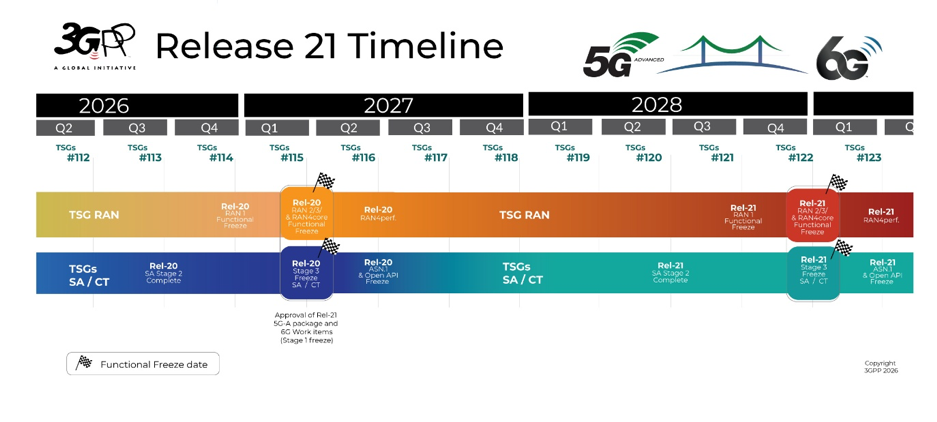
The approximate standardization timeline for Release 20 and Release 21 for 6G is as follows.
-
1) Release 20 (June 2025 – June 2027): Review Stage for 6G Requirements and Key Technologies
- • Completion of SA1 service requirements study: June 2024 – March 2026
- • Ongoing studies on SA2 architecture, SA3 security, and RAN technologies: June 2025 – June 2027
-
2) Release 21 (Timeline to Be Finalized in June 2026Full-Scale 6G Specification Development Expected to Begin in 2027
- • Initial drafting of 3GPP 6G technical specifications is expected.
- • Alignment with the IMT-2030 submission timeline is anticipated.
-
1) Release 20 (June 2025 – June 2027): Review Stage for 6G Requirements and Key Technologies
Please note that detailed schedules are subject to change depending on the outcomes of future 3GPP meetings.
-
2. Key Technical Directions for 6G
-
1) AI-Native Networks
Discussions are underway on incorporating AI as a fundamental element of the network. Key areas under review include AI-based network operation, resource management, service optimization, and support for AI model training and inference. -
2) Integrated Sensing and Communication (ISAC)
Discussions are also underway on enabling communication networks not only to transmit and receive data, but also to sense their surrounding environment. This would allow networks to identify the location, speed, and shape of vehicles, UAVs, pedestrians, obstacles, and other objects, and to support applications such as autonomous driving, smart cities, and industrial automation. -
3) Ubiquitous Connectivity
6G aims to reduce coverage gaps and ensure communication continuity even in disaster situations by integrating terrestrial networks with non-terrestrial networks such as satellites and HAPS*. Positioning and time synchronization functions that do not rely solely on GNSS are also important topics under discussion. -
4) Support for Immersive Services
Support for advanced services such as XR, holograms, remote healthcare, remote education, and digital twins is also a key direction for 6G. To enable these services, ultra-low latency, high reliability, high data rates, and precise media synchronization will be required. -
5) Support for Various Device Types
Various device types are being considered from the early stages of 6G development. The scope is expected to cover not only high-performance devices, but also a wide range of product categories, including IoT devices, low-power devices, XR devices, and industrial equipment.
-
1) AI-Native Networks
-
3. RAN Technology Discussion Items
In RAN, key items related to 6G radio access technologies are being reviewed. Major technical topics under discussion include waveform and modulation schemes, channel coding, maximum channel bandwidth, frame structure and numerology, reference signal structure, and the RAN-Core interface. In addition, discussions are also underway on the transition from 5G to 6G, the use of new spectrum in the 7 GHz band, and ways to improve coverage and energy efficiency. In particular, discussions on 6G standardization are aiming to avoid overly complex structures and pursue a simpler and more efficient standard.
-
4. Key Discussion Items on 6G Cybersecurity
As AI, sensing, non-terrestrial networks, and various device types are being considered for 6G, security architecture has also become an important area of study. 3GPP SA3 is currently studying the 6G security architecture and major security threats, and is currently identifying the security areas and risks relevant to 6G systems.
The topics under review include security architecture, RAN security, UE-Core Network security, authentication and key management, quantum-resistant authentication, and network exposure security.
Among these topics, quantum resistance has been highlighted as an important requirement, particularly Quantum Resistant Authentication designed to address threats from quantum computing. Research related to Post-Quantum Cryptography is also underway.
-
5. Key Terms
- • SA3: A 3GPP working group responsible for security-related standards
- • AI-native: An architectural concept where Artificial Intelligence is integrated as a fundamental, inherent element of the system.
- • ISAC: An acronym referring to technologies that natively unify wireless communication and environmental sensing functionalities into a single system.
- • NTN: An abbreviation for Non-Terrestrial Network, referring to communication systems that utilize assets located above the Earth's surface, such as satellites or HAPS.
- • HAPS: An abbreviation for High-Altitude Platform Station, referring to a platform that provides communication services from high altitudes
- • XR: An abbreviation for Extended Reality, referring to extended reality technologies including AR, VR, and MR
- • Key Hierarchy: A structured architecture of cryptographic keys used systematically for authentication and encryption.
- • Post-Quantum Cryptography: Advanced cryptographic algorithms designed to secure systems against potential attacks and vulnerabilities introduced by quantum computers.
-
6. Key Summary
3GPP is currently pursuing both the advancement of 5G-Advanced and preparatory research on 6G within Release 20, with full-scale 6G specification work projected to begin in Release 21.
Rather than being discussed simply as a faster mobile communication technology, 6G is envisioned as a next-generation communication platform. This architecture inherently integrates AI-native networks, integrated sensing and communication (ISAC), non-terrestrial network (NTN) interworking, immersive services, support for diverse device types, and enhanced security frameworks.
Although detailed specifications have not yet been finalized, 6G is expected to have a profound impact on future mobile communication products and service architectures. Consequently, continuous monitoring of these evolving standardization trends remains essential.